Tiddley-Bits tea

Tiddley-Bits tea

Thursday, 14 October 2010

{giving thanks}

thank you, dunyabad, shukriyah, grazie, gracias, merci, danke

thank you. Two simple words we use everyday. We use them with people we know, with people we don’t know, & with people we love.  I spent Canadian Thanksgiving with my middle sister, Christina, & her husband,  Sam and my niece, Anahita in Toronto. Anahita is 20 months and she is learning how to speak. One of the first expressions we teach our children is ‘thank you’. It may be a variant that they actually use: “ta’ or ‘da yu’ …but they are the first words that we use to teach children how to be civilised.  These two words are usually the first we learn in another language. Before travelling, we make sure we know how to say hello & thank you in a foreign tongue. These are the words we use everyday when we accept something, when someone holds the door for us, when someone gives us a huge present, or when someone gives us something small, when we take the coffee we’ve just paid for from the barrista, or when we receive an assignment from a student, or when we take the change we are owed from the grocery cashier. Why do we say thank you when we are being given back what we are owed? It’s a token of gratitude that is used for a variety of purposes on a constantly shifting scale.
I worked for Meinhardt’s (a high-end grocery store in South Granville, Vancouver) in undergrad as a way to pay for my education. I remember, one evening as I rung the groceries through for a customer, I asked him  “How are you?” He replied with “why ask? As if you care.” I remember thinking that if we were to remove all the little forms of civility and gratitude from everyday speech acts, the world would be a scary, sad & very unfriendly place. No please & thank yous. no smiles. no laughs. But with the season of  thanksgiving, I can’t help but wonder, do our ‘thank yous’ really matter? Has the meaning & value from the word been erased? Are our ‘thank yous’ just a matter of habit, and when do we really stop to think for what we are thankful for?
Thanksgiving has a varied history, and its date for celebration varies from country to country. Living in America, Thanksgiving is something that comes right before the Christmas season in November. In Canada, it signals the end of summer and the beginning of fall. In the UK it is the Harvest Festival, which goes back to pagan celebrations.

{Thanksgiving table at Christina's, Toronto}

{love love love brussel sprouts!!}


{Christina in her *new* kitchen serving up thanksgiving dinner: roast beef & yorkies}

Growing up, grace was always said or sung at meal time. It offered us a chance to reflect on the gratitude we all shared for the food set before us. After all, another word for grace is ‘giving thanks’. In a family of 5 girls, & with parents who hardly ever took a salary as they attempted to get a non-profit organisation off the ground, we were thankful for enough food to feed all the mouths at the table. We were often the recipients of the food hamper at Church at Thanksgiving. We were thankful for the large bountiful basket of food that arrived on our front porch with a thud. In a world wracked with famine I do think we ought to stop before we eat, and remind ourselves of how lucky we are for that sandwich, that cup of tea, or that roast beef dinner set before us.
But we should be thankful for so much more. We should be thankful for the troublesome times in life. It is only with lack that we are able to understand and appreciate the presence of something. Travelling for weeks out at sea with no fridge, no freezer, and usually in southern climes, arriving in port and receiving a glass of ice water was the biggest treat I could as for at 6. But most 6-year-olds nowadays don’t feel that it’s enough to have a fridge stocked full with all sorts of drinks. The more we have the more we want.  When I visit my parents on their boat, I am quickly aware of the incessant and sometimes ridiculous amount of amenities we have on dry land. Coming back to shore after spending a few days on the boat I am always pleased to find myself rejoicing at the simple things we take for granted: the flow of a fresh water shower and the flush of a toilet (after having to pump the head  or use a bucket of saltwater for one’s washing).  I am always reminded anew of the great luxuries we have on dry land. Similarly, it is only after we’ve suffered an awful cough or flu, that finally being recovered we rejoice in being well again. How grateful we are for health when we know what it’s like to be sick.
It is why travel always is often the best way to remind us of how lucky we are to have the comforts of ‘home.’ Particularly if we’ve travelled to underprivileged areas of the world, where water is a luxury, where a bed and a home & a pillow to rest one’s head is a dream.
This Thanksgiving I am extremely grateful for the health & well-being of my family: my parents, my sisters, their husbands & my nieces & nephews. All in their far-flung  corners of the world: some dealing with political coups in South America, others dealing with hurricane floods in Mexico, all of us dealing with the daily challenges of everyday life, of health issues, of managing a household, balancing family & work…I am grateful for being born into a loving family, with four best friends built in, and two adventurous & enthusiastic parents.
I want to be thankful for a holiday that makes us stop & reflect on what we should be thankful for. Rather on focussing on what we don’t have, or what we haven’t yet achieved, I want to make us stop & think about all the things that we DO have. And most importantly I want us to stop & reflect on the simple things in life. Since it’s often the simplest things in life that mean the most to us. In the words of Paolo Nutini:
So I'll cherish the simple things
The easy took for granted things
Like going round my Mum's house for my tea
And argue with my sister,
Only God knows how I missed her
It's the simple things that mean the most to me
-“Simple Things”, Sunny Side Up, (2009)

{Some photos from my trip}


{Niagara Falls from the greyhound bus window}


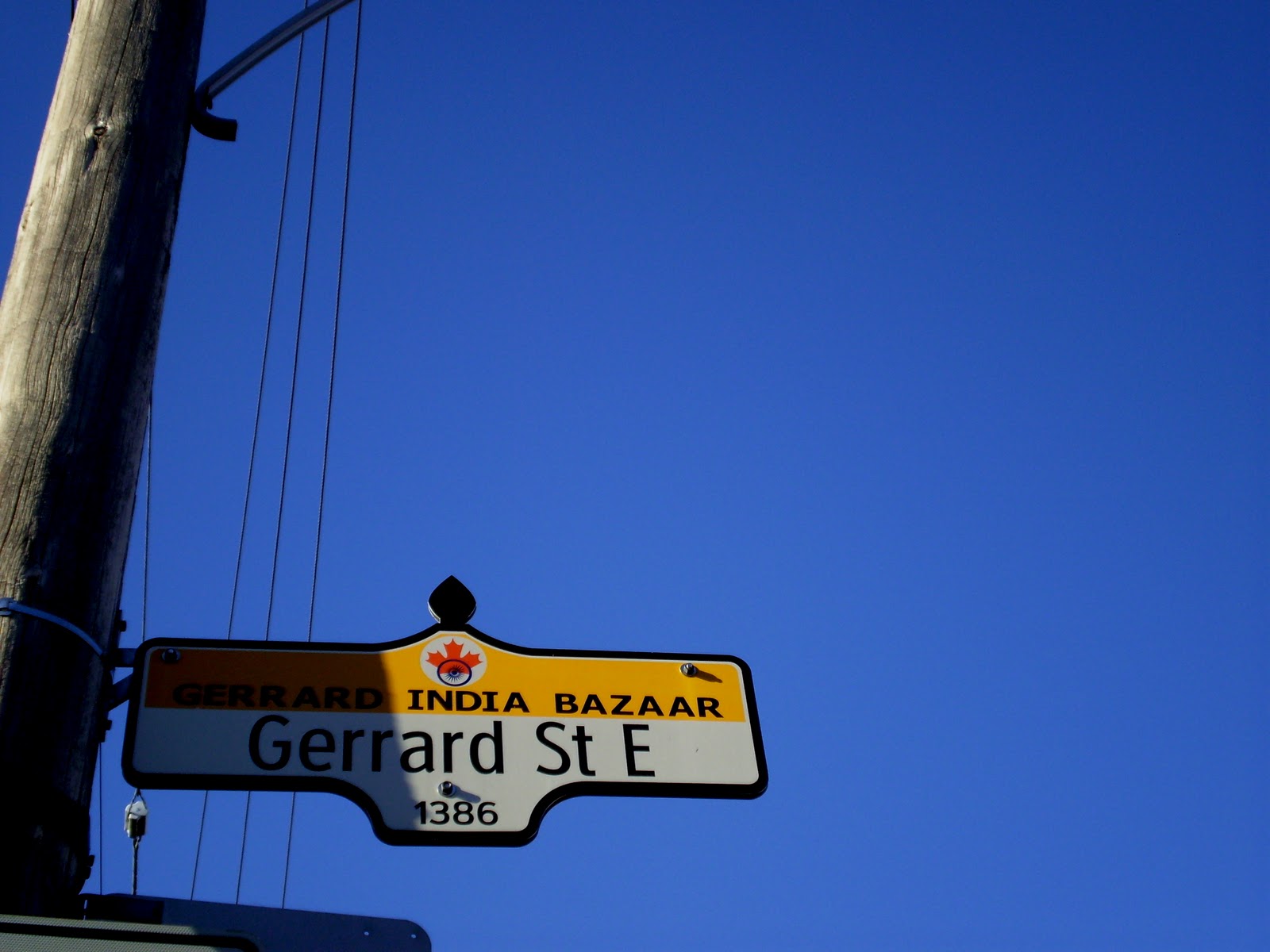
{trip to Gerrard Street, Toronto-a little India with plenty of great food to eat & great salwar kameez, fabrics for saris & bangles to choose from}


{the best Pakistani cuisine: Lahore Tikka House. totally reminds me of the Peshwari BBQ we had in Peshawar, where my father was born (he also spent his early years in Lahore)}

{check out the decorations at the Tikka house--a truly unique experience}


{a putput & a rikshaw outside the restaurant}


{adorable bangles I bought for my niece}


{great food to be had on Gerrard St}


{super yummy brunch at Whitlock's, where they have a great buffet & a guy who makes omelettes made-to-order from the window opening on to the street (behind)}


{thanks Crick & Sam for brunch!!}


{my sister & her husband are renovating a beautiful character home. the house is decorated with some great finds from all over. Here, some of the cutest tea cups E.V.E.R. Our step-grandma was an avid teacup collector, and while we thought they were kind of ugly as kids, we are all super happy now to have inherited such dainty things to sip tea out of!}

{my sister is super brilliant--she did her MA at Cambridge & her PhD at Oxford. I love these sorts of things that are littered about the house, reminiscent of her days in the UK and our family's heritage in England. I believe this was a gift from our Great Cousin Charles & his wife, Liz}


{me & my niece outside her house}


{cool old signs mark the streets of Toronto}


Thursday, 7 October 2010

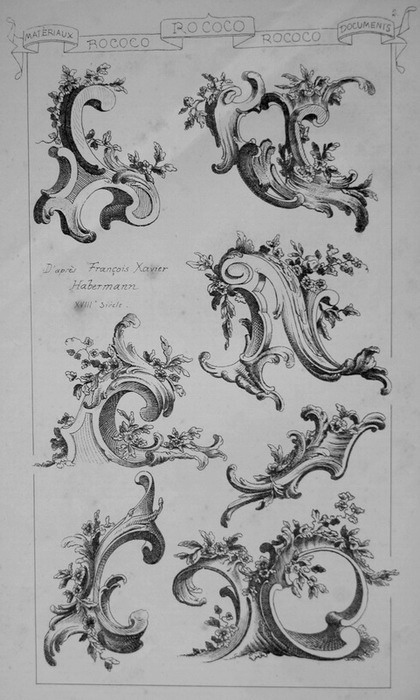
{oh la la...Rococo}

I taught my freshmen this week on the Rococo. While I don't particularly love the frivolity and the over-the-top-with-a-cherry-on-top style of the movement, I do--I have to admit--like some of it...But really, I like the sorts of things the movement inspired. Departures from the movement itself.

{Speltz, A., The Styles of Ornament, pl. 317 and 318. From Universidad de Navarra}
{The Cabinet of Count Bielenski, plate 87 in Works of Juste-Aurèle Meissonnier Designed by Juste-Aurèle Meissonnier (French, 1695–1750); Etched and engraved by Pierre Chenu (French, 1718–after 1767); France, 1742–48 (designed 1734); Etching and engraving on off-white laid paper}
The word "Rococo" combines the Portuguese word barroco (an irregularly shaped pearl & may be the source of the word baroque) & the French word rocaille (the artificial shell or rock ornament popular for gardens). Its used to define the refined, fanciful & often playful style that became fashionable under Louis XV (& often associated with his Mistress, Madame de Pompadour). It was a favoured style of an aristocracy that devoted itself to the enjoyment of witty conversation, cultivated artifice, and playful sensuality.
{I'd like to frame some of these "rocaille" inspired prints. from Universidad de Navarra}
The rococo style is generally characterized by pastel colours, delicately curving forms, dainty figures and a light-hearted mood.
It has often been interpreted as a reaction against the art identified with the formality & rigidity of 17th c-court life under Louis XIV, the Sun King, or Roi Soleil.
The Duke of Orléans, regent for the boy-king Louis XV settled in Paris & the rest of the court (moved from the palace at Versailles) built elegant town houses (known as tels) with interiors fashioned in the Rococo style. The hôtels became the site for intellectual gatherings, called salons (also the name used for the room itself), hosted by educated women of the upper class. One example is the Hôtel de Soubise:
{Germain Boffrand, Salon de la Princesse, Hôtel de Soubise, begun 1732, Paris, France}
Modern inspirations of the Rococo in wall paper:
{"Nama Rococo" from Neublack}
In the nineteenth century there emerged a revival of Rococo, such as these illustrations of Rococo interiors:


{I like the pastel greens. From The Textile Blog}
This Rococo-inspired modern artwork by Maki Tamura is pretty cool:

{Maki Tamura, Rococo, watercolor on paper, wood. From Lucas Schoorman's Gallery}
& I like this Rococo revival bed:

{Unfortunately it's £1,195.00 , available at Interior Delights}
I like this DIY project from design*sponge of a paper clock with rococo-inspired paper:

Check out this Rococo-inspired chalkboard:
{$36 from SeeJaneWork}
{How about this crazy dress?}

Or this elegant rendition from Marie Antoinette?
With these shoes?


{from Londonnet}
I like this Rococo Revival brooch:

{1870s Rococo revival available for the small sum of $1175 at jewelryexperts}
 How lovely is this Fleurs Rococo wallpaper?


{Charles Newhaven Interiors}
I love these rococo-inspired birds by ParisBreakfasts:

{You can buy them on Etsy}


Or check out these Ladies-in-Waiting plates from anthropologie:


For an excellent exhibit on the Rococo see Cooper-Hewit:

An added note: my dear friend, Jenni, has just informed me of an online game where you can decorate your own salon. check it out at le grand salon

Saturday, 2 October 2010

{Charade}


One of my favourite movies is Charade--it has been a favourite since High School. I was crazy about Audrey ever since I can remember...I was captured by her elegance and her poise...and her fashion sense.
When I was in High School, my older sisters were living in Vancouver, attending university & one weekend when they were visiting we decided to rent Charade. 


Audrey (Regina or "Reggie") returns to Paris only to discover her beautiful apartment is in disarray and her husband is dead.

{note the LV luggage in the first shot}


 She also discovers that she really didn't know her husband or his identity and that there are numerous men who are after funds, it seems, that he has stolen. She is summoned to the US Embassy where she meets CIA agent Hamilton Bartholomew (or so she thinks). He informs her Charles was involved in a theft during WWII--Charles, "Tex" Panthollow, Herman Scobie, Leopold W. Gideon and Carson Dyle were parachuted behind enemy lines to deliver $250,000 in gold to the French Resistance. Instead, they buried it, but were then ambushed by a German patrol. Dyle was badly wounded and left to die; the rest got away. Charles double-crossed them, digging up the gold and selling it. He was killed but the money remains missing – and the U.S. government wants it back.


All she is left with is his Lufthansa travel bag, which contains a wallet (with no sign of the 250,000), a notebook, & an unsealed envelope with some stamps. She is now confronted with this unsavoury, yet hilarious cast of characters.
 Who can she trust? To begin with she confides in Cary Grant, only to discover that his identity keeps changing every 15 minutes or so, and all those involved seem to end up dead (& in their pyjamas). After the third murder, Inspector Grandpierre notes, "Three of them. All in their pyjamas? C'est ridicule! What is it, some new American fad?"
 If the plot sounds familiar, it's because the Truth About Charlie (2002) starring Thandie Newton follows the same plot.

The fashion in Charade is great. Check out this outfit housed today at the Newbridge Silverware Museum of Style Icons :

{An evening ensemble by Givenchy: two-piece cocktail outfit comprising a fitted sleeveless top and corresponding skirt of black wool moss crêpe trimmed with imitation jet pailletes, lined in black silk -- made for and worn by Audrey Hepburn as Regina "Reggie" Lampert in the 1963 Universal film Charade.}
The soundtrack is pretty great too. The theme song "Charade" is one of my favourites--I love Harry Connick's version of it, on his album Come by Me. You can listen to it here. Or you can watch the original on YouTube
I also love the part in the movie when Audrey has to play spy. She's not sure the true identity of this man that she's been hanging out with (Cary Grant). What girl doesn't like the idea of being a spy? As a kid, I'd keep a little 'spy book' with me, recording all the funny details of people around me. It's what, in the end, gave rise to Tiddley-Bits, my own comic strip of hilarities recording happenings of interests from travels & everyday life in the Clark family.


{Audrey in disguise}


Check out these outfits inspired by Audrey's sleek & chic looks:


{Available on Polyvore}


There are some pretty hilarious moments...some pretty funny sayings. Some that have now become common use in the Clark household (& by extension, by my nieces & nephews). To begin with, when Audrey asks Cary Grant "How do you shave in there?"


Or the hilarious "Tex" who is a constant source of laughter with his expressions like "jumpin' frijoles"; "She batted them pretty little eyes at you, and you fell for it like an egg from a tall chicken!"  Or the words he uses in a fight: "You greenhorn. Why you thick skulled, hairbrained, half-witted, greenhorn." You can hear it here .

{Tex}


{Sylvie: "It is infuriating that your unhappiness does not turn to fat!"}

 The marionette scene is also fantastic--I just love marionettes:

{Punch & Judy in the Jardins des Champs Élysées, Paris}

How does it end?  Well I won't spoil it for you.
 You can watch Charade on liketelevision or you can also see it on Hulu
But to give you a hint, & another favourite quote from the movie (also seen in Pretty Woman when Julia Roberts is watching TV): "Oh, I love you, Adam, Alex, Peter, Brian, whatever your name is, I love you! I hope we have a lot of boys and we can name them all after you!"